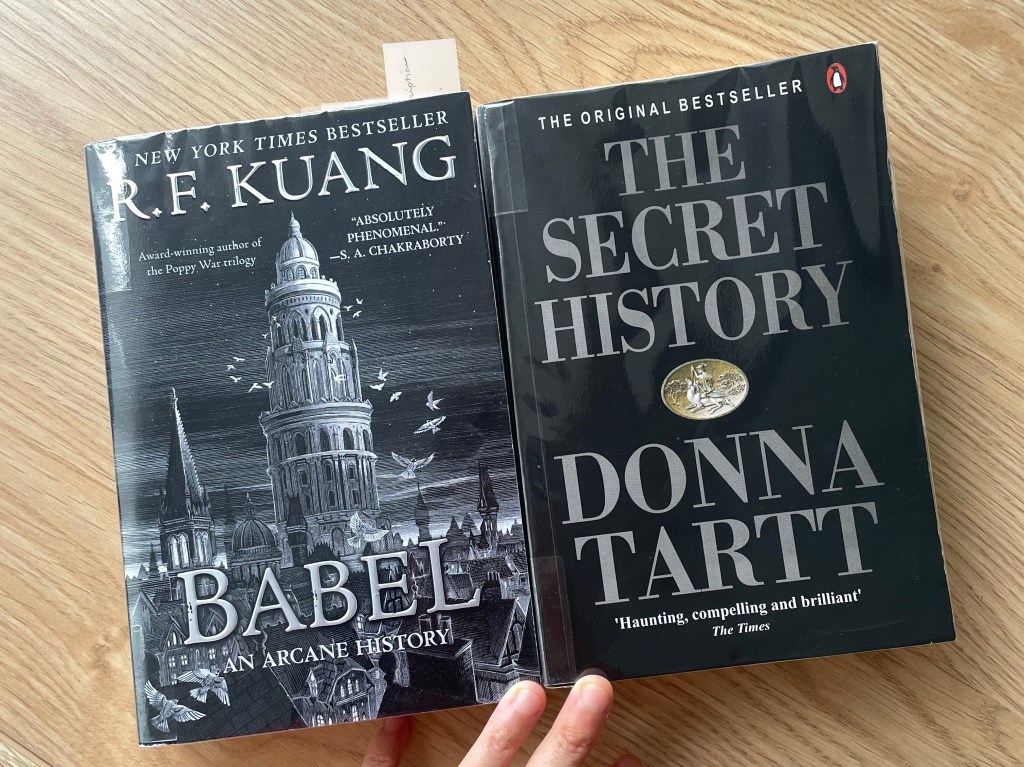
What do RF Kuang’s Babel and Donna Tartt’s The Secret History have in common? Besides being deeply engaging, compelling, heart-wrenching, and impossible to put down? And of course, both being written by exceptionally intelligent and gifted female authors?
It’s this: a perfectly paced scene that culminates in the quick yet intense death of their formidable, adversarial character – a catalyst for the protagonist’s inner turmoil and identity crisis throughout the story.
These scenes shattered me. Both times, I sobbed through the fall of the body, feeling like I was running (and stumbling) towards the edge of the cliff, pausing at the final words before plunging into the abyss.
And those finals words…
You see, the thing about reading Babel is that you’re so spellbound by the way Kuang tells her story, you find yourself searching for the meaning, formation, and origin of every word you come across – not just in the book, but in real life too, as you (reluctantly) snap back to it.
I am so absorbed in the whole reading experience, I even found myself arguing with my imagined version of Kuang when Robin decided to engrave ‘Understand’ as the match-pair word for 明白 instead of ‘Enlightened’ – which I still think would’ve been more fitting, considering Robin (or Kuang, actually) theorised that 明白 ‘has the visual component of making clear, to shine a light on’.
Just to be clear, at the time of writing this particular piece, I had not finished reading Babel yet. I was only about to reach Book IV, but I felt compelled to share my experience mid-way through. It’s intense. It’s mystifying. Most importantly, I felt (and still feel) profoundly connected because I could vividly picture the Oxford she describes: from Summertown to Woodstock, Jericho (where I stayed when I was there last Summer) to Banbury Road, Cherwell, Broad Street, High Street – oh, it’s endless. It feels so real in my mind. I imagined myself trying to keep up with Robin and Griffin as they briskly walked through the streets during their secret rendezvous, carefully avoiding being seen together.
I think it’s brilliant how she plopped Babel between the Rad Cam and the Sheldonian Theatre. I can visualise the land expanding there, stretching out and pushing up against these two iconic buildings and All Souls’. What a superb, fantastic imagination Kuang has!
But wait, I’ve deviated from my main point, as I often do because there’s so much I want to say, but it’s too much work to sort everything out. Somethings spilling it all out without bothering about the proper order feels like the best thing to do.
As I was saying: those final words… leading to those gut-punching deaths in Babel and The Secret History.
‘Father, […]’ – Babel
‘I love you.’ ‘Come in.’ – The Secret History
(I won’t linger too much on the texts as I don’t want to ruin it for those who have not read the novels.)
Those final words felt the most alive in those final moments – paradoxical, yet congruent. They were revelations, and they were conclusions. Most of all, they were declaration and confessions. I am struck, once again, by how powerful and consequential words are.
As a writer, being captivated by words is nothing new to me. But the more I read, the more I marvel at how each author sculpts them into their own works of art. There are endless combinations to play with endless ways to shape stories, and endless voices and cultures that bring them to life.
Ultimately, both Babel and The Secret History remind me of the profound impact that words can have, not just in storytelling but in shaping our emotions and perceptions. What stories have moved you in a similar way?
Thanks so much for reading! Don’t forget to share it with anyone who might enjoy it.
If you enjoyed reading this, feel free to subscribe to my page – it’s free, and you’ll get all my latest posts while supporting my work!


Leave a Reply